|

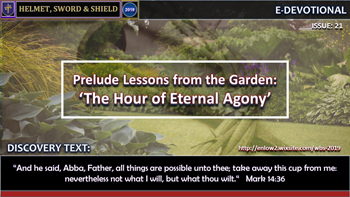
Lessons from the Garden: 'The Hour of Eternal Agony'
"And he said, Abba, Father, all things are possible unto thee; take away this cup from me: nevertheless not what I will, but what thou wilt."
Mark 14:36
Turning our focus to the dramatic ordeal of our Savior in the Garden of Gethsemane (“an olive mill or press for olives”), we observe that in that semi-private sphere He had begun to contemplate the true gravity of the climactic entirety of the redemption events that He was appointed to experience.
In His human frame He began to stare the impending moment (“the hour of eternal agony”) squarely in the face and began to entertain the sheer horrors of its realities.
The scene before us is wholly literal and fully human in its presentation. Here, we observe the full portrait of the measure of the raw humanity of the Savior as conveyed in the deep expression of His present weighty burden through His words, "My soul is exceeding sorrowful unto death. (Mk. 14:34b)
Not also, we observe that the Lord Jesus was not shielded from any aspect of the human experience. Assuredly, we are shown that He experienced it across its entire full spectrum.
To this point, the prophet Isaiah accurately foretold in Isaiah 53:4a, "Surely he hath borne our griefs, and carried our sorrows."
Then, too, this experience was immensely something more than that. Here, the Lord Jesus was fully contemplating the dreadfully painful contents of "the Cup."
Now, we dare not believe that His experience of grappling with emotional trauma was remotely comparative to ours because He confronted His dilemma from a vantage point that we can never occupy.
Namely, the Lord Jesus did not have to deal with the interplay and influence of a sin nature that always affects us in some way. Thus, how can we who are inherently sinful begin to understand the supernatural experience that the Lord had to struggle with; in a frame of impotent humiliation?
In our spiritual ignorance, we withhold due thanks that belong to God, and He alone; then we arrogantly boast of the enduring capacity of "the human spirit," and applaud some imaginary energy re-energize ourselves to ascend after we have plummeted down near toward the cellar of death.
Truly, what inherent ability do we possess to overcome that which is supernatural in essence? We do not even possess the ability to cure the common cold, let alone possess the capacity to defeat the power of death.
THE INTENSITY OF THE MOMENT
We must remember as 2 Corinthians 5:21a denotes, "For he hath made him to be sin for us, who knew no sin."
Hence, His ordeal was one that cannot be fathomed by human thought regardless of how much time we expend in our efforts to analyze and examine it.
The sheer intensity and the serious gravity of the situation is captured in Luke 22:43-44. The passage describes, "And there appeared an angel unto him from heaven, strengthening him. And being in an agony he prayed more earnestly: and his sweat was as it were great drops of blood falling down to the ground.”
Hence, we see that supernatural enabling was needed in order spiritually re-energize the Lord to be prepared to confront the impending moment that was hastily approaching.
Indeed, the Lord was deeply pondering the paramount matters of redemption that were at hand. On an earlier occasion in John 12:27, He had telegraphed and described this very moment: “Now is my soul troubled; and what shall I say? Father, save me from this hour: but for this cause came I unto this hour.”
Too, He was fully aware of the approaching brutal assault of His spiritual foe, commencing with the imminent event as He described in Luke 22:53b. The passage reads, "but this is your hour, and the power of darkness.”
But too, He yet was more than ready to submit to the will of God, as was detailed to us: "And he was withdrawn from them about a stone’s cast, and kneeled down, and prayed, Saying, Father, if thou be willing, remove this cup from me: nevertheless not my will, but thine, be done.”
Now, how about us (Christ followers)? Typically, where do we fit in the broader scheme of the extended scene of this climactic matter of eternal redemption?
The answer to that question is not cloaked or mysteriously hidden from us. In fact, the subsequent verse sadly showcases the position/posture we (Christ followers) find ourselves occupying; namely: "And when he rose up from prayer, and was come to his disciples, he found them sleeping for sorrow."
www.hss-bsa.com
"click on selection to view"

|
|
|
|
March 30, 2019
Mark 11:32-36 (KJV)
FRAGMENTS-BSA 2019

VISIT THE ONLINE
RESOURCE WEBSITE
WBS Online
(CLICK HERE)
If you have further questions regarding what you have just read; or if you would like further information on how to become a "born again" follower of Jesus Christ, please feel free to contact us at: cog_online@att.net, or write us at: Church of Grace, 8307 Bluff Avenue, Centreville, Illinois 62203. We would be delighted to further assist you. Remember, "Seek ye the LORD while he may be found, call ye upon him while he is near:" (Isaiah 55:6)
©2019 HSS All Rights Reserved