|

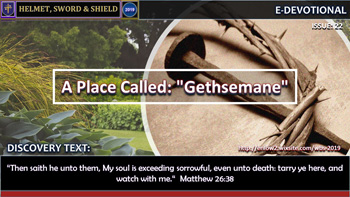
A Place Called: "Gethsemane"
"Then saith he unto them, My soul is exceeding sorrowful, even unto death: tarry ye here, and watch with me."
Matthew 26:38
With the arrival of the Savior and company to this pivotal place of transition that would serve as the gateway threshold or “stepping-stone” path that would lead to the climactic, epic redemptive event that would transpire at the Cross, atop Mt. Calvary; we observe an obvious significant shift in the view of impending event by both the Savior and the Disciples.
Now, with respect to the Lord Jesus it was not the case that unfolding matters would be different from those that He had already repeatedly forewarned about; but, on this occasion we are shown His expressive response concerning them in a much deeper and broader fashion.
In regard to the Disciples, their shift in the view of the pending future became more obscured and uncertain despite the fact that the Lord Jesus had given them clear and plain instruction about what to expect.
As cited in the opening verse of this dramatic chapter, the Lord Jesus had definitively declared to the Disciples in verse 2: “Ye know that after two days is the feast of the passover, and the Son of man is betrayed to be crucified.”
But, not only did that affirmation arouse inner impression of foreboding dread in their hearts; then afterwards while residing the house of Simon the Leper, after heart-shocking event transpired the intensified this same sentiment and surfaced thoughts of great concern in their hearts.
Namely, after being anointed with precious oil that was graciously and lovingly bestowed upon by a woman from the broken shell of a valuable alabaster box, the Lord Jesus further explained: “Why trouble ye the woman? for she hath wrought a good work upon me. For ye have the poor always with you; but me ye have not always. For in that she hath poured this ointment on my body, she did it for my burial.” Matthew 26:10-12 (KJV)
Indeed, these and other prior final upper room events (i.e. identifying the internal traitor and the commissioning of the ordinance of Holy Communion); all served to captivate the central focus of their mind’s eye; and became the fixated preoccupation of their hearts on this unusual night occasion.
In essence, what was ultimately transpiring was the beginning of the unfolding of greater redemptive matter that the Lord Jesus had earlier commonly and critically referred to as, “the Hour!”
Alluding the dramatic events that would comprise the trying ordeal known as “the Hour,” the Lord Jesus had earlier publicly remarked in John 12:23b: “The hour is come, that the Son of man should be glorified.”
Then, subsequently, triumphantly subdued an inner tremor of wrestling impulse of His humanity by earnestly expressing, then assuredly affirming in John 12:27: “Now is my soul troubled; and what shall I say? Father, save me from this hour: but for this cause came I unto this hour.”
And, as has been graphically conveyed to us in the holy record, the notably momentous events that transpired at this key location (i.e. “the placed called Gethsemane”) that had been placed in the routing path of redemptive destiny were immensely essential in terms of providing all parties the needed opportunity to spiritually “prepare” for the impending traumatic ordeal that hastily awaited each them.
Again, from the monumental events that have been pointedly showcased (in one degree or another) in all accounts of the inspired volumes of the Gospel, the criticality of ‘spiritual preparation’ (i.e. the primacy of earnest, supernatural prayer) is particularly identified as a paramount essential in the life arena of spiritual warfare and conflict.
www.hss-bsa.com
"click on selection to view"

|
|
|
|
April 1, 2019
Mark 11:32-36 (KJV)
FRAGMENTS-BSA 2019

VISIT THE ONLINE
RESOURCE WEBSITE
WBS Online
(CLICK HERE)
If you have further questions regarding what you have just read; or if you would like further information on how to become a "born again" follower of Jesus Christ, please feel free to contact us at: cog_online@att.net, or write us at: Church of Grace, 8307 Bluff Avenue, Centreville, Illinois 62203. We would be delighted to further assist you. Remember, "Seek ye the LORD while he may be found, call ye upon him while he is near:" (Isaiah 55:6)
©2019 HSS All Rights Reserved